What to check before you install a Quran app
There is no single best Quran app, because the readers are not the same person. Someone memorising needs repeat and word audio. Someone rebuilding a lapsed habit needs to be brought back on a Tuesday. Someone who learned on an IndoPak mushaf needs that script and nothing else will do. What can be settled is the evidence: twelve things that are true or false about any Quran app, each of which you can check yourself in about a minute.
Before anything else. We do not claim Quran Habit is the best Quran app, and nothing on this page is written to say so. Everything here is a fact you can check for yourself, in the app or in the sources we link. Which app is best is your decision, and it is a decision worth making on your own reading rather than on anyone’s ranking, ours included.
The app is free to install and the whole Quran is free to read on this website with no account at all, so the cheapest way to test any sentence below is to open the thing it is about and look.
Two pages here, and they do different jobs
We publish a second page about choosing a Quran app and it is deliberately not this one. Our comparison of seven Quran apps names each one, quotes it from its own materials, records the date we read them, and says for every app where it is ahead of ours. It is the page to open if you want a list.
This page names nobody. It is the method rather than the verdict: the questions we would ask about any Quran reader, in an order that puts the cheap checks first, so that you can reach your own verdict about any app on any store, including the ones neither page has heard of.
The twelve checks
Each one is written so a stranger can answer it. If a check here cannot be answered without taking someone’s word for it, it does not belong on this page and we have got it wrong.
-
Is the Quran text itself free, and does it stay free?
Plenty of apps are free to install and then meter the reading: a chapter a day, a translation behind a tier, a mushaf view that asks for a card. The question is not the install price, it is whether the reading is the thing being sold.
How to check it: Install it, open a long surah, and read past where a free tier would usually stop. Then open the app’s own terms or store listing and look for the sentence that says what a purchase changes. If no such sentence exists, that is your answer.
Quran Habit: The Quran text, the translations, the recitations, the mushaf page view, the tajweed colouring and the offline downloads are free to every reader of the app, subscribed or not. That was measured in the app’s own source on 10 September 2026 and is written out in full on our licences page. This website charges for nothing at all.
-
Are there adverts, anywhere, on any tier?
An advert in a Quran reader is not only an interruption. It is a third party deciding what appears beside the text, and you cannot audit that list.
How to check it: Google Play prints a "Contains ads" label on a listing when the developer declares ads. Open the Play listing and look under the install button. It is a label you cannot fake.
Quran Habit: None anywhere, and our Play listing carries no "Contains ads" label.
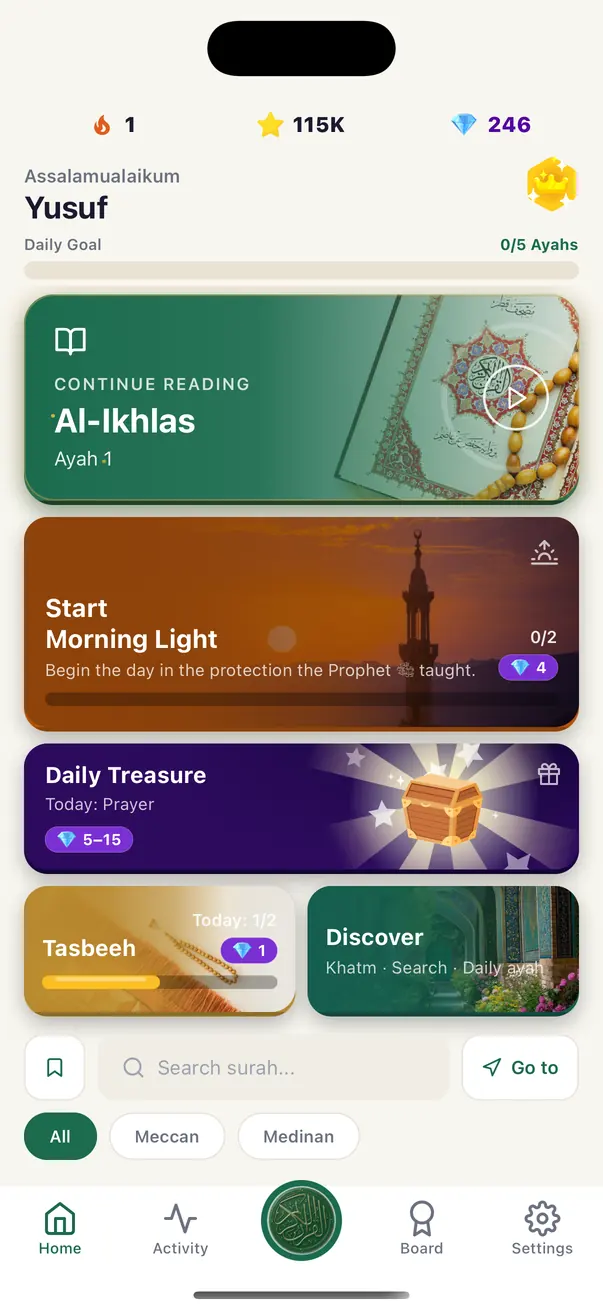
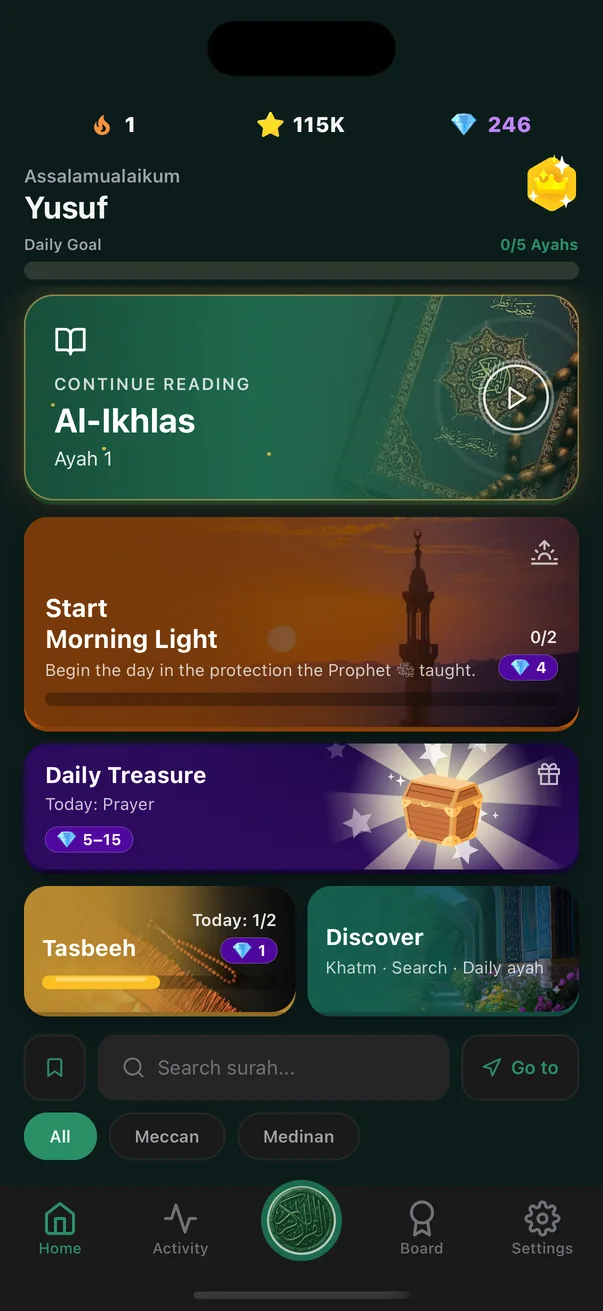
The home screen, whole. No advert anywhere on it, and no slot where one could go. -
Can the app name the mushaf its Arabic comes from?
Two apps can show the same ayah and disagree about where the page breaks, where a juz starts and which marks sit over which letters. An app that cannot name its edition cannot be checked against a printed copy at all.
How to check it: Find the app’s credits or sources screen. It should name a text, a publisher and a font. Then open a printed mushaf you own at any page and compare the first and last word of that page with the app.
Quran Habit: The Quran text follows the QPC Hafs digital mushaf published by the King Fahd Glorious Quran Printing Complex in Madinah, rendered in the KFGQPC UthmanicHafs font. The app says so on its own Credits and Content Sources screen, and our licences page says it again with the licence each source is used under.
-
How many ways can you actually read the page?
People do not all read the same script. A reader raised on IndoPak will struggle with Uthmani spacing and the other way round, and neither is a preference an app should make you argue with.
How to check it: Open the reading settings and count the entries under script or mushaf. Ignore themes and font sizes; count only the ones that change the letterforms or the page layout.
Quran Habit: 4 scripts and 10 ways to read the mushaf, which is the count both of our store listings print in their own words.
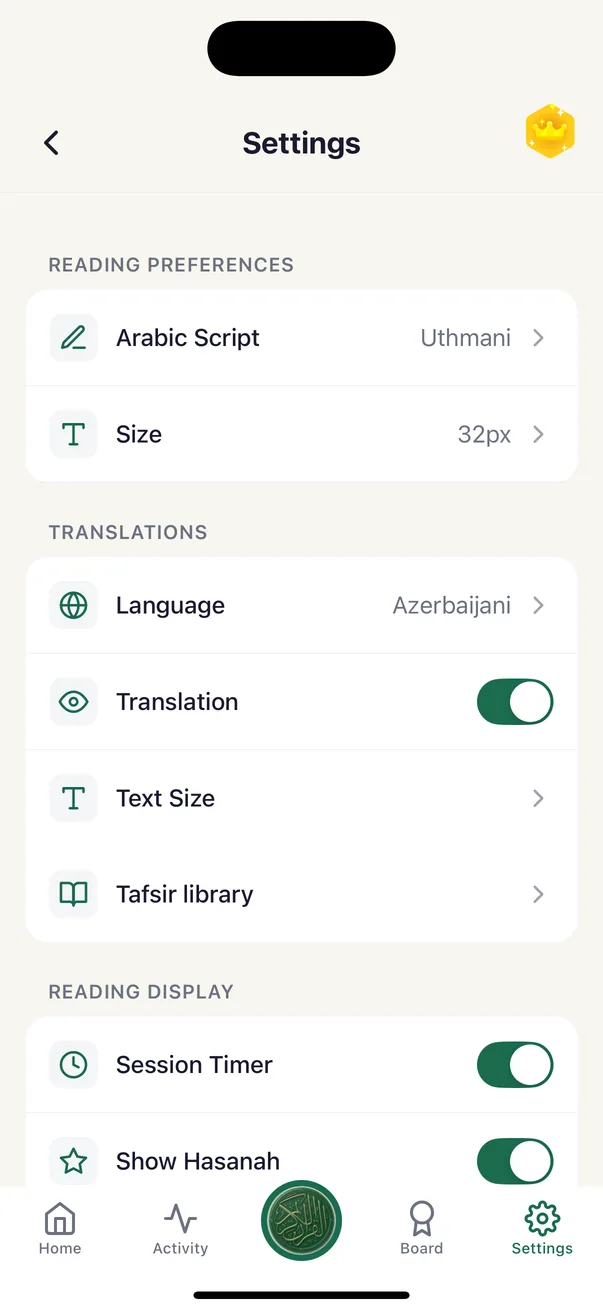
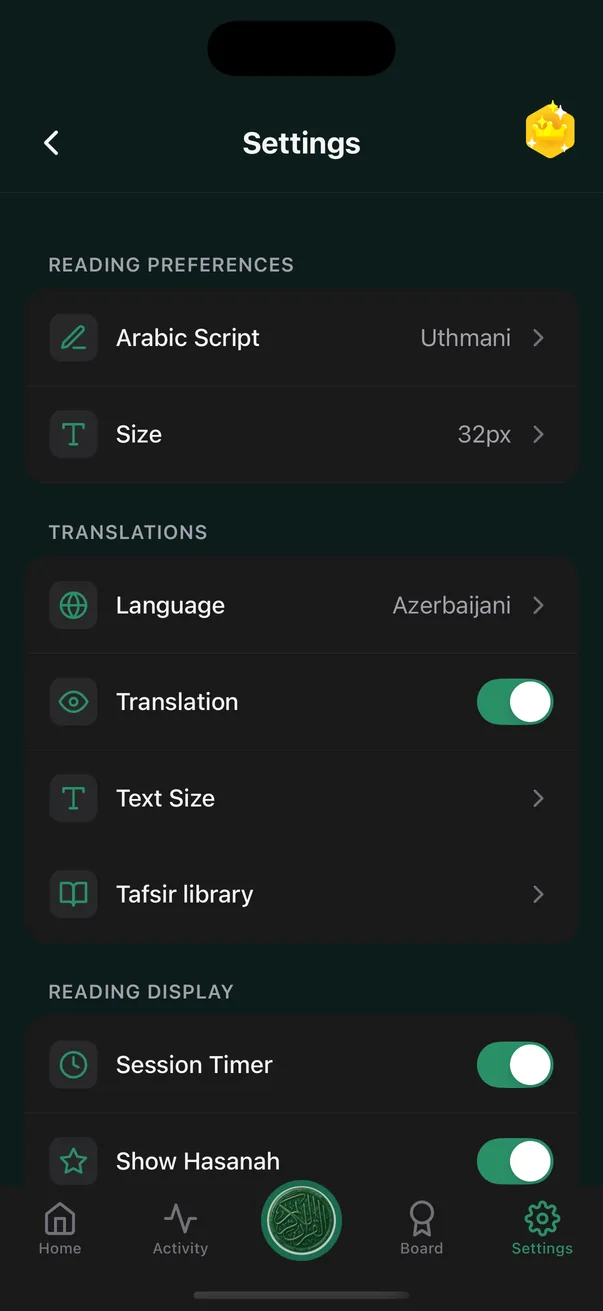
Arabic Script is the row that changes the letterforms. This capture is on Uthmani. -
Is there a meaning under each individual word?
Word by word is the difference between reading a translation of an ayah and beginning to read the ayah. It is also the feature most often promised and least often complete.
How to check it: Open a long ayah in the middle of the Quran, not al-Fatihah, and check that every word carries a meaning rather than the first few. Then switch the app to a second language and check the same ayah again.
Quran Habit: Word by word meaning in 14 languages with per word audio. What we do not have is the grammar layer some readers want: no root, no lemma, no morphology, no verb forms. We give the meaning and stop.
-
Does the audio line up with the words, or only with the ayah?
Ayah level audio is easy. Word level timing is what lets the highlight follow a reciter across a line, and it is what makes listening useful while you are learning to read.
How to check it: Play an ayah and watch. If a highlight moves word by word with the voice, the app has per word timings. If the whole ayah lights up at once, it does not.
Quran Habit: 11 of the 40 reciters carry word level timing. On this website the timings come from a published, attributed dataset under Creative Commons Attribution 4.0, and the credit is on our licences page because that licence is the reason we may serve them.
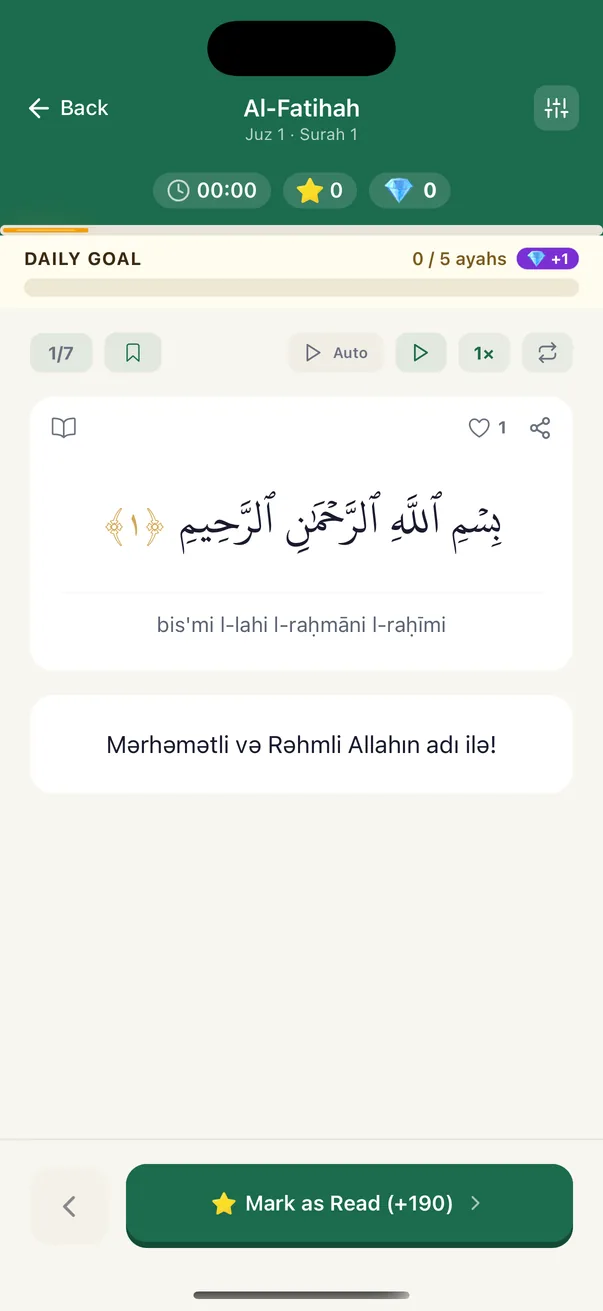
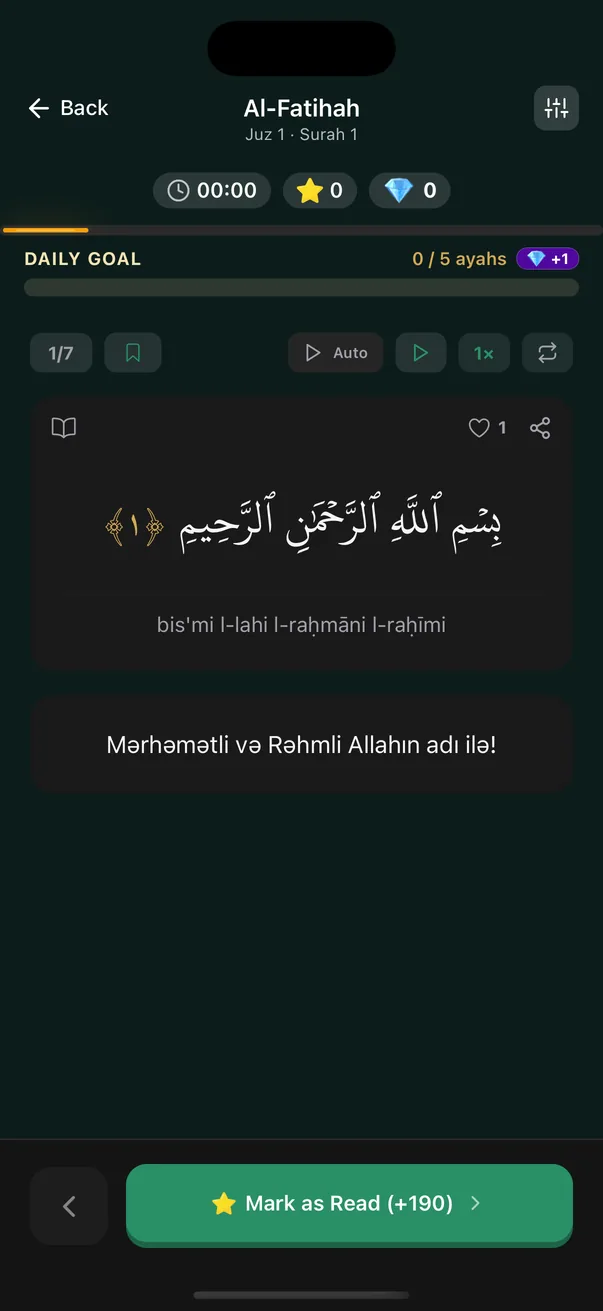
The reader. The button reads +190 because the basmala is 19 Arabic letters and the app counts ten a letter. -
What still works with the connection off?
The reading happens on trains, on planes, in basements and in Ramadan queues. An app that needs a network to show you an ayah will fail you exactly when you have time.
How to check it: Turn on aeroplane mode and open the app cold. Not resume it: close it first. Then try to open a surah, a translation and a recitation, one at a time.
Quran Habit: The whole Quran in four scripts plus the word by word meanings ship inside the app and need no download and no connection: both our store listings state that in line 13 of their descriptions. Reciters and page image mushafs are downloads you choose, per surah or in full, and deleting one gives the space back. What still needs the network is a reciter or a page image set you have not downloaded, and everything social: the leaderboard, the weekly leagues and syncing your progress to a second device. Reading itself does not.
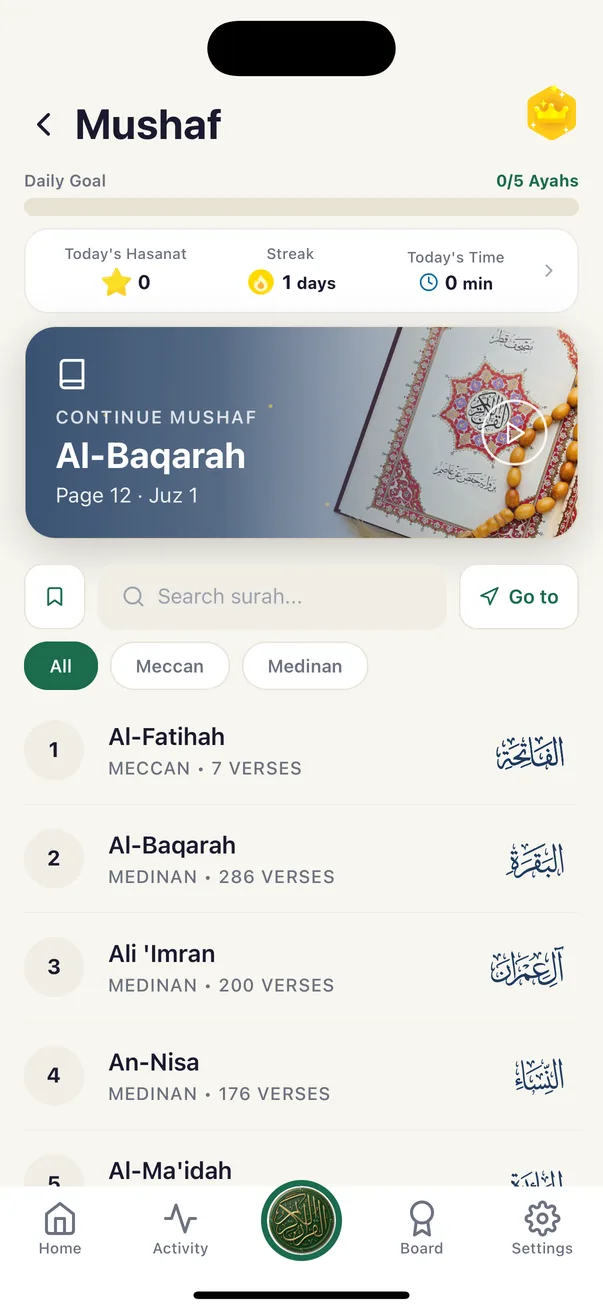
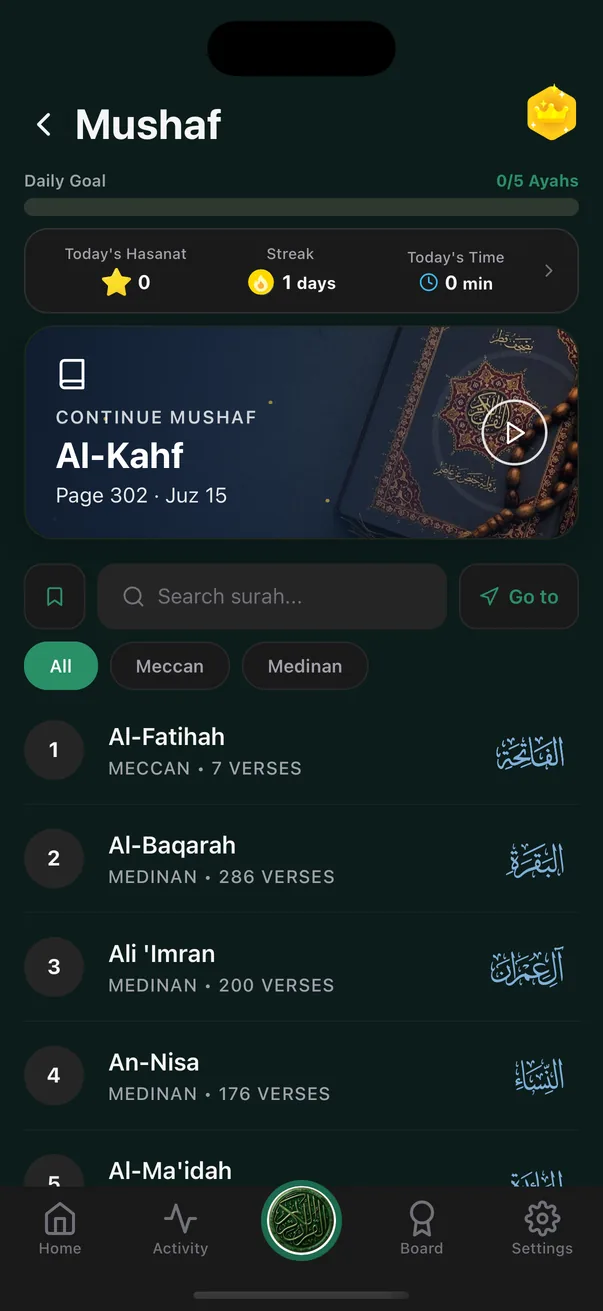
The mushaf tab remembers the page you were on, which is the part that matters with the signal off. -
Does anything help you come back tomorrow?
Most people who stop reading do not stop because the app was bad. They stop because nothing brought them back on the day they were tired, and a reader that is only a library leaves that entirely to you.
How to check it: Look for three things and see whether you can switch each one off: a daily target you choose, a record of the days you read, and a reminder whose time you control.
Quran Habit: A daily goal of 1, 5, 10, 20 or 50 ayahs, a streak, a dated khatm plan, and reminders that are individually switchable and capped at six a day by one shared limit. One ayah is a real option and it is there on purpose: a goal you can meet on your worst day is the one that survives. The reading plan has its own page, and the khatm calculator does the arithmetic without installing anything.
-
What happens on the day you miss?
This is the question that separates a habit tool from a scoreboard. A design that punishes the first missed day loses the reader on the second.
How to check it: Skip a day on purpose, early, while you have nothing to lose. Watch what the app does and how it speaks to you the next morning.
Quran Habit: The streak is counted from yesterday when today is still empty, so it does not fall to zero at midnight while you still have the evening. A gap of up to two days is repaired free, and a repair always requires reading: gems are an additional cost for a bigger gap, never a substitute for opening the Quran.
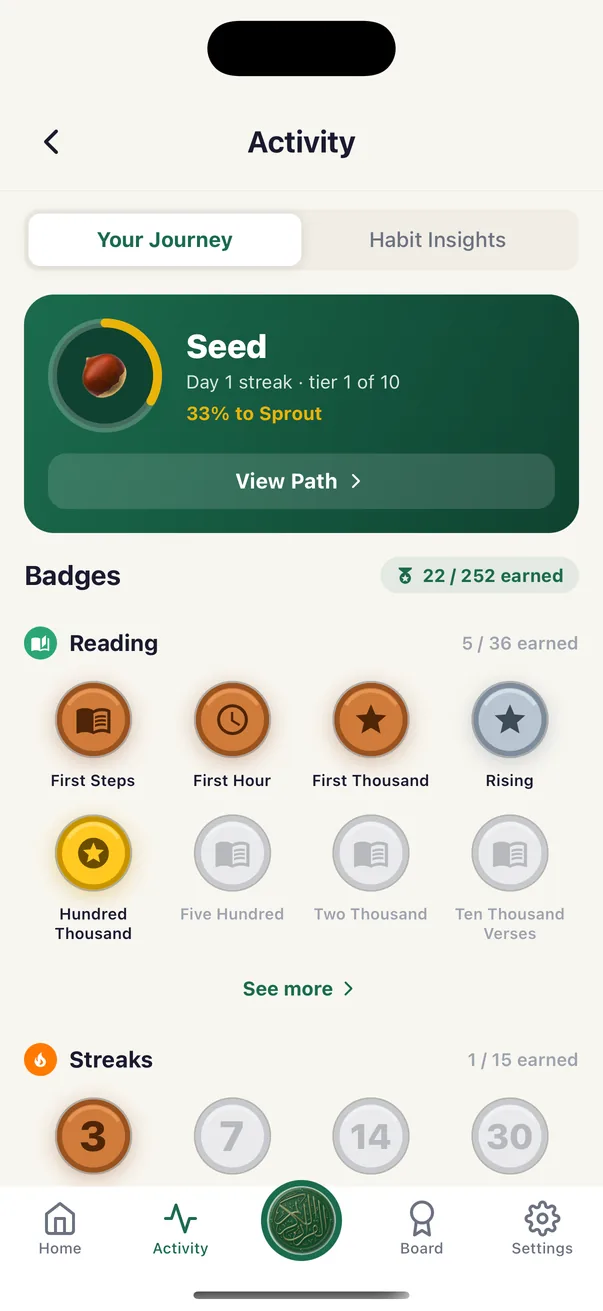
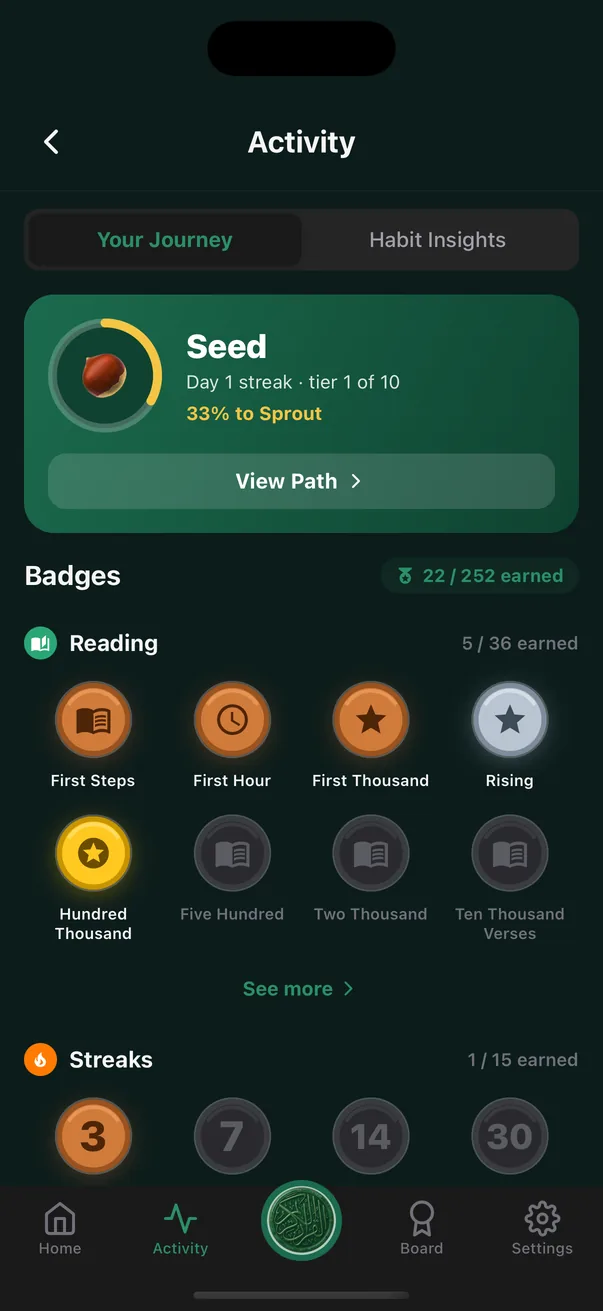
The record of days. Ten growth tiers, and the badge counts say how many of each set are earned. -
Does it tell you where its data came from?
Translations, recitations, tajweed markup and page images all belong to somebody. An app that will not say whose work it is showing you has either not checked or would rather you did not.
How to check it: Look for a credits, sources or licences screen. A real one names the work, the holder and the terms. A list of logos is not one.
Quran Habit: The app has a Credits and Content Sources screen, and this website publishes a longer licences page that states, source by source, what we hold and where the permission comes from, including the places where it is still unresolved.
-
What does a purchase actually change?
Not whether there is a paid tier. What the paid tier moves. That is the sentence that tells you whether you are buying support or buying access to scripture.
How to check it: Read the paid screen carefully and write down every line it promises. Then check each line against the free app. The gap is what you would be paying for.
Quran Habit: A purchase changes a badge beside your name on the leaderboard, your full name where a free reader’s is shortened, and a doubled daily gem rate outside Ramadan, when every reader already has one. It changes nothing about the reading. The app also sells packs of gems, its in app currency, which its own terms say has no monetary value. This website sells nothing.
-
What does it refuse to do?
An app that answers every question with yes has stopped answering. The refusals tell you what it is for.
How to check it: Ask for the three things you would most want and see how many it claims. Then check the two or three it claims hardest.
Quran Habit: No speech recognition of any kind: the app never listens to you recite and will never tell you a word was wrong. No prayer times, no qibla and no compass in the app. No word grammar. The source is closed. Reading ayah by ayah is portrait: the mushaf is the one screen that turns with the phone.


Where to go next
Some of the twelve are big enough to have their own page, and each one is written the same way this is, with the screenshots and the sources:
- Reading with tajweed colour, which is part of check 4: what the colours mark, what they cannot teach you, and the contrast measurement behind them.
- How to memorise the Quran, which is checks 8 and 9 pushed to their hardest case: the arithmetic behind the usual promises, and the four things the app refuses to do for a memoriser.
- The Quran by the numbers, if what you actually came for was the counts: surahs, ayat, words, juz and why the page total depends on the mushaf.
- The reading plan, and the khatm calculator if you only want the arithmetic without installing anything.
- Learn to read the Arabic script, from the letters and their joined forms up to the tajweed rule families, with real ayat rendered in colour in your browser.
And if you would rather not install anything at all, the whole Quran is on this site: all 114 surahs with the Arabic, a translation and audio, with no account and nothing to download. You can also listen to any surah ayah by ayah, and read any of the 30 juz straight through.
What Quran Habit will not do
The refusals are as much a part of choosing as the features, so here are ours in one place rather than scattered through the twelve.
- It never listens to you. There is no speech recognition of any kind in the app, so it cannot tell you that a word was mispronounced. If a recitation checker is what you are looking for, this is the wrong app and you should know that now rather than after installing.
- No prayer times, qibla or compass in the app. Those live on this website only.
- No word grammar. You get the meaning of each word. No root, no lemma, no morphology, no verb forms.
- Closed source. You cannot read the code, so several of the checks above have to be run on the app rather than on a repository.
- The reader does not rotate. Reading ayah by ayah is portrait, and so is every other screen. One screen is the exception and it is the mushaf: turn the phone there and the page turns with it.
How this page is kept honest
Every count on this page is read from a single fact sheet, which is re-measured against the shipping app rather than copied from a document, and the pages that print those counts are held to them by an automated check on every release. The claim that a purchase changes nothing about the reading was measured in the app’s own source on 10 September 2026, with a control that found the three places a purchase does change something, and it is written out with those three on our licences page. Quran Habit reached Google Play on 5 September 2026 and the App Store on 7 September 2026. Nothing on this page quotes a rating or a download count, including our own: a number the publisher benefits from is not evidence, and the two store listings already carry whatever readers have left there.
Questions
So which Quran app is the best one?
We are not going to answer that, and an answer from the people who make one of them would be worth very little anyway. The twelve checks on this page are the questions we would ask, each written so you can answer it on any app in a minute or two, and the answer you reach is worth more than ours because it is about how you read.
How is this different from your comparison page?
Our comparison page at /en/best-quran-apps/ names seven real apps and quotes each one from its own dated materials, which is a different job with a different risk: it can go stale the week an app ships a release. This page names nobody and asks you to run the checks yourself, so it stays true whatever anyone ships.
How would I tell "free to read" from "free to start reading"?
Metering shows up at a boundary, so go and find one. Open the longest surah in the app, scroll past the first fifty ayat, switch the translation to a second language, then play a recitation. An app that meters the reading stops you at one of those four moments and names a price. Check 1 above says what ours does and where that was measured; this is how you answer the same question about an app we have never seen.
Is it on both iPhone and Android?
Yes. Quran Habit arrived on Google Play on 5 September 2026 and on the App Store on 7 September 2026. Both listings are live, and qht.app/getapp sends you to the right one for the device you are holding.
Do I need an account?
Not to read. An account exists to save your progress and sync it between devices, and on this website the whole Quran is readable with no account at all in fourteen languages.
Why is there no star rating or download count on this page?
Because we would be quoting our own. A rating on a page published by the developer is not evidence, it is a screenshot of a number we benefit from. The store listings carry whatever readers have actually left there, and that is the right place to read them.
Whose judgement should I trust instead of yours?
Your own, and then people who have used the app for longer than a week: the reviews on the two store listings, and anyone you know who reads daily. The app is free, so the cost of forming your own view is one evening.
What does Quran Habit not do?
It never listens to you recite, so it cannot tell you that a word was wrong. It has no prayer times, no qibla and no compass. It shows the meaning of each word but no root, lemma or morphology. It is closed source, and the mushaf is the one screen that turns with the phone.
How do I check an app for adverts without installing it?
Open its Google Play listing and look under the install button for the "Contains ads" label. Google puts it there from the developer’s own declaration, so it is one of the few claims in an app store that is not written by marketing.
If I only have time for one of the twelve checks, which one?
Aeroplane mode. Turn the connection off, close the app completely, then open it and try to reach an ayah. It takes thirty seconds, it cannot be argued with, and it tells you more about how an app was built than any feature list.
The Quran, word by word, and a daily reading habit in one free app.