
Quran Habit vs Quranly
This page is published by the makers of Quran Habit. Every Quranly fact below comes from their own public materials, read on 17 September 2026, and the rows where Quranly is ahead are argued first rather than last.
You know exactly what your problem is. You do not read most days, and you are looking for the app that fixes that.
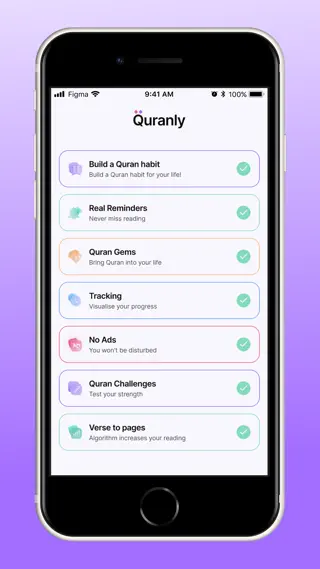
This is the only comparison in the cluster where the other app is aimed at the same thing we are. Quranly calls itself "The world's first habit-building Qur'an app", and its materials are almost entirely about the habit: a daily goal from two minutes upward, daily streaks, a weekly leaderboard, a friends list, reminders. There is no argument to make about whether habit-tracking belongs in a Quran app, because both of us have already answered yes.
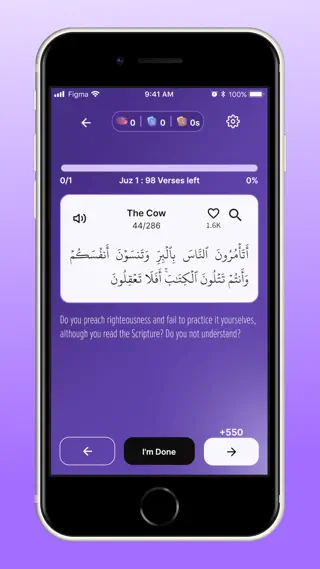
So the comparison comes down to a question neither app's marketing usually asks: what you are looking at while the streak counts, and what the count does with a verse you have already read. On the first, their own feature article says more than their store listings do. It names a "Classic Mushaf Format", transliteration, seven qaris and "Translation in 18 Languages". What it does not name, and what nothing on their site or in either listing names, is a script, a printed edition, a line count or a page-for-page claim. Their App Store listing declares one app language, English.
That is not a claim that the reading surface is bad. We have not used it and this site does not review apps it has not been given materials for. It is a claim about what they publish, and for an app you might read in every day, that is a fair thing to weigh.
The count is the other half, and it is the part habit apps usually leave you to work out for yourself. Quran Habit asks you to pick a rule. In Daily Reading an ayah earns again every new day, which is what you want if you are going back over the same short surahs. In Khatm mode each ayah earns once, so the number on screen is how far through the Quran you have been rather than how much reading you have done. The setting names the two and prints the arithmetic under each.
There is also more in the app than the reading and the streak: 84 Quranic duas, the 99 names, a tasbeeh, and a morning set and a night set of passages you tick once and it remembers. Their feature article, which sets out to cover everything the app does, lists none of those. More surfaces is not automatically better. If the streak is all you came for, each one is something else to ignore, which is the argument the next section makes for them.
One more row where they say nothing and it costs real money: their paid tiers run $4.99 a month, $29.99 a year, and two separate lifetime entries at $79.99 and $199.99, with nothing on the listing distinguishing the two. What the paid tier unlocks is not described anywhere in their materials.
Read from their site, both store listings and their own feature article on 17 September 2026.
Where Quranly beats us
On focus. Quranly does one job and keeps to it: a goal, a streak, a weekly leaderboard and the reading under them. Quran Habit puts a great deal more on the screen, and more is not free, because every surface is one more thing to learn or ignore. If the streak is the only thing you want from an app, theirs is the smaller one to carry and that is a real argument for it.
What Quran Habit is
A free Quran app and website built around one idea: that the hard part is not finding the Quran, it is coming back to it tomorrow. Everything below is free to read, with no advertising anywhere. On this page the argument is not about whether streaks work. It is about what is on the screen while they count.
- The mushaf you know. Page-accurate images, all 604 Madani pages, plus IndoPak at 610 and Naskh at 612.
- 43 translation languages and a 13-language interface, right to left for Arabic, Persian and Urdu.
- Word by word meanings in 14 languages, with per-word audio for learners.
- 40 reciters, 11 of them with word-level timing so the word highlights as it is recited.
- Tajweed colour script, and 4 scripts in all.
- Habit, not guilt. Streaks built to survive a bad day, khatm plans, and 33 weekly reading leagues.
- 84 Quranic duas and the 99 names, and the Hijri seasons the khatm plans are built around.

 Quran Habit is on Google Play and the App Store.
What Quran Habit looks like
Our own screens, from the shipping app. Quranly's own App Store screenshots are further down this page, taken from their listing.


The feature table, in this comparison's order
The habit rows near the top are close. The reading rows below them are where the two apps stop resembling each other.
Yes: their materials state it. No: they state its absence, or it is checkable from outside and checkably absent. Not stated: they are silent, which is never counted as a missing feature. We are held to the same rule, and our own column is read from our own store listings the same way.
- 8 rows Quran Habit states and Quranly's materials do not
- 0 rows Quranly states and Quran Habit's do not
- 4 rows both state
- 4 rows neither states
| Feature | Quran Habit | Quranly |
|---|---|---|
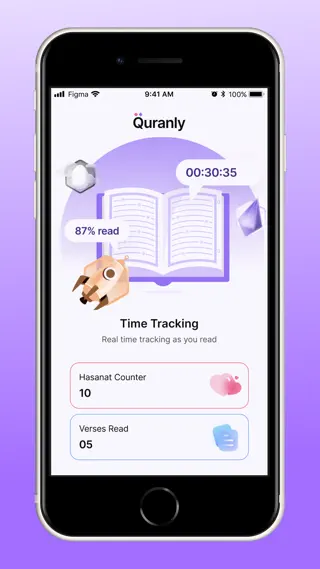
| Reading streak Does it count consecutive days of reading? | Yes Built to survive a bad day rather than punish one. | Yes The core of the app: a daily goal from "2 mins all the way up to an hour plus", plus "Daily Streaks", reminders, and the trackers their App Store description names, "verses, pages, time and hasanat". Quranly's own site and their App Store listing, read 17 September 2026 |
| League or leaderboard Are readers ranked against other readers? | Yes 33 weekly reading leagues, plus streak and friends tables. | Yes Their site states what theirs ranks on: "The leaderboard will rank you based on your reading for the week", among the friends and family you add yourself. Quranly's own site and their App Store listing, read 17 September 2026 |
| Khatm plan Is there a dated plan for finishing the whole Quran? | Yes Dated plans, including the seasonal ones. | Not stated No completion plan is mentioned in any of their four documents. The goal is a daily amount, in minutes on their site and in verses in their article, not a finish date. Quranly's own site and their App Store listing, read 17 September 2026 |
| Page-accurate mushaf Does a page on screen match a page of a named printed mushaf? | Yes All 604 Madani pages as page images, plus IndoPak at 610 and Naskh at 612. | Not stated Their article names a "Classic Mushaf Format": "A beautiful feature allows readers to recite the Quran using the classic Mushaf." No printed edition, no line count and no page-for-page claim appears with it. From the same feature article; neither store listing mentions a mushaf format at all. Quranly's own site, read 17 September 2026 |
| Quran text free Can you read the whole Quran without paying? | Yes Free to install; the whole Quran is free on this website with no account. The text and the word-by-word are never put behind a paywall. | Not stated Free to start, with tiers at $4.99 a month, $29.99 a year and two lifetime entries at $79.99 and $199.99. What the paid tier unlocks is not described anywhere in their materials, so whether reading is gated cannot be read off them. Their App Store listing and their Google Play listing, read 17 September 2026 |
| More than one script Is more than one mushaf script or edition offered? | Yes 4 scripts, 10 mushaf choices. | Not stated One format is named, the classic Mushaf. No script is named anywhere in their materials, and no second edition is offered or ruled out. Quranly's own site, their App Store listing and their Google Play listing, read 17 September 2026 |
| Word-by-word meaning Is there a translation under each individual word? | Yes Word-by-word meaning in 14 languages, with per-word audio. | Not stated "Word by Word Verses" appears in their App Store release notes. It is not in the current listing description and no languages are named. Their App Store listing, read 17 September 2026 |
| Tajweed colouring Is tajweed shown as colour in the reading view? | Yes A tajweed colour script, one of the four. | Not stated Their release notes mention "Tajweed Fixes". No colour-coding claim was found. Their App Store listing, read 17 September 2026 |
| Word-level audio Is audio aligned to single words, not only to whole ayat? | Yes 11 of the 40 reciters carry word-level timing. | Not stated Not stated. Their App Store listing and their Google Play listing, read 17 September 2026 |
| No adverts Is the free tier free of advertising? | Yes None anywhere, and Google Play carries no "Contains ads" label on our listing. | Yes Their own feature article has a section headed "No Ads": "An outstanding feature of Quranly is the complete absence of advertisements." Play carries no "Contains ads" label either. The quote is from their feature article "Quranly: Everything You Need to Know", on their own site. Quranly's own site and their Google Play listing, read 17 September 2026 |
| Word grammar and roots Are root, lemma, morphology or verb forms shown per word? | No No root, no lemma, no morphology, no verb forms. We give the meaning and stop. | Not stated Not stated. Their App Store listing, read 17 September 2026 |
| Works offline Do their materials state that reading works with no connection? | Yes Both our store listings state it: the full Quran offline in four scripts, and any reciter kept on the device by surah or in full. The page-image mushafs are downloads. | Not stated Not stated in their materials. Quranly's own site, their App Store listing and their Google Play listing, read 17 September 2026 |
| Prayer times in the app Does the same app also give prayer times, Athan or Qibla? | No Not in the app: no prayer-time screen, no qibla. They exist on this website only. | Not stated Not stated. Quranly's own site and their App Store listing, read 17 September 2026 |
| Checks your recitation Does it listen to you recite and flag mistakes? | No No speech recognition of any kind. The app never listens to you. | Not stated Not stated. Their App Store listing and their Google Play listing, read 17 September 2026 |
| Source code public Is the source published under a licence anyone can read? | No Closed source. | Not stated Not stated in their materials. Quranly's own site, read 17 September 2026 |
| iPhone app Is there an App Store listing today? | Yes On Google Play and the App Store. | Yes A live App Store listing. Their App Store listing, read 17 September 2026 |
The Quranly documents every row above was read from
- their App Store listing, read 17 September 2026
- their Google Play listing, read 17 September 2026
- Quranly's own site, read 17 September 2026
A row rests on one of these or it is not here. A claim from a help centre with no stable address is named in the cell instead of linked.
Reading streak
Both, and theirs is the more single-minded of the two. A goal measured in minutes, from two upward, with a daily streak against it. Ours is built around the day after the day you missed, because that is the day people quit on: a gap of a day or two comes back after one guided reading session, a longer gap costs gems as well, and the reading is always required, so gems never buy a streak back on their own. Their materials name "Daily Streaks" and, in their App Store version history, "Streak Improvements", and do not say what happens when one breaks.
League or leaderboard
Both rank readers weekly, and their site says plainly what theirs ranks on: "The leaderboard will rank you based on your reading for the week", among the friends and family you add. Ours places you in one of 33 leagues with weekly promotion and relegation, among readers you are matched with rather than people you had to invite, and there is a second board beside it that ranks on the longest streak, globally or in your country. Which of those you want is a question about whether you would rather be measured against your own record or against the week.
Khatm plan
Ours, twice over. Their goal is an amount, not a destination: nothing in their four documents plans a finish date for the whole Quran. Ours schedules one against a date, including the seasonal plans people actually start, and the Khatm counting mode above sits under it, so the total on screen is the part of the Quran you have been through rather than a running tally.
Page-accurate mushaf
Ours, and this is the row that decides the page. Quran Habit reads as page images of all 604 Madani pages and names the edition, with IndoPak and Naskh beside it. Their article names a "Classic Mushaf Format" and stops: no printed edition, no line count, no page-for-page claim. The difference reaches the habit as well as the reading, because in Quran Habit one press marks the page in front of you as read and credits the verses printed on that page of the edition you are in. What their article describes is page counting, a "Pages" tracker that works "by keeping count of the number of pages you recite".
Quran text free
Theirs is "free to start" and we cannot tell you what starting ends at, because their materials do not say what the paid tier unlocks. Ours is free to read, on the app and on this website, and the text and word-by-word meanings are never put behind a paywall.
More than one script
Ours, on the same silence as the row above: four scripts and ten mushaf choices, each edition named, against one format named and no script at all.
Word-level audio
Ours, with a limit worth printing. Tap a word in Quran Habit and you hear that word, in the readers and on the mushaf editions whose word boxes we measured ourselves. Two of the page-image editions carry no word boxes at all and the picker says so before you open them, which is the honest version of this feature rather than a claim that it works on every mushaf. Their release notes list "Word by Word Verses", with no language named and no audio claim.
What Quranly shows on its own listing
Their images, not ours. These are the first 3 screenshots on Quranly's App Store listing, read on 8 September 2026. They are what the publisher chose to show, and none of them was taken from inside the app.
Choose Quranly if
Choose Quranly if you want the simplest possible version of this idea and the reading surface genuinely does not matter to you. It is a smaller app than ours and for some people that is the point.
Positions itself as "The world's first habit-building Qur'an app".
⚠️ Corrected 17 September 2026, and all three corrections went their way. The rows above had been read from their website and their two store listings only. Their own feature article states three things none of those documents do: "Translation in 18 Languages", a "Classic Mushaf Format", and a section headed "No Ads" claiming "the complete absence of advertisements". It also names four levels of "Quranic Challenges" with badges. The article is in the source list below, and where it disagrees with anything on this page, it wins.
What their materials still do not describe is the reading surface. Across their website, both store listings, their release notes and that article there is no script named, no printed edition, no line count, no page-for-page claim and no offline statement. That is what "not stated" means in the rows above; it is not a claim that the features are absent.
Choose Quran Habit if
Choose Quran Habit if you want the same streak attached to a page-accurate mushaf, a khatm plan with a date, a counting rule you pick yourself, word-by-word meaning in 14 languages, a way back after a missed day that does not start from zero, and a price you can see before you pay it.
The bottom line. Two apps built for the same problem. Only one of them names the mushaf you will be reading from.
Questions
What makes Quran Habit one of the best Quran apps?
The table above, rather than a slogan. Against Quranly it gives Quran Habit eight of the sixteen rows: Quran text free, Page-accurate mushaf, More than one script, Word-by-word meaning, Tajweed colouring, Word-level audio, Khatm plan and Works offline. Under all of them sits one reading surface: 604 Madani pages as page images, IndoPak at 610, Naskh at 612. If the streak is the only thing you want, theirs is the simpler app and this table is more than you need.
Why does reading a little every day beat one long sitting?
Because 604 pages spread over a year is under two pages a day, and the same 604 pages in one weekend is not something anyone repeats the weekend after. A daily reading habit is arithmetic before it is anything else: a small number you keep finishes the mushaf, a large number you admire does not. Quranly counts days too, and the table above gives them that row.
How does Quran Habit build the habit?
Four things, all of them rows in the table above. Streaks built to survive a bad day rather than punish one. Dated khatm plans, including the seasonal ones. 33 weekly reading leagues. And word-by-word meaning while you read, with 11 of the 40 reciters carrying word-level timing. No khatm plan appears in Quranly's materials, which is why that row sits on our side of the table.
How does the reading league work?
You are placed in a weekly group of readers, the group is ranked by what you read that week, the readers at the top move up a league, and everyone starts fresh on Monday. There are 33 leagues in all, with a streak table and a friends table beside them. Quranly ranks readers as well, so this row is a draw rather than an argument.
Which languages can I read the Quran in?
43 translation languages in the app, an interface in 13, and word-by-word meaning in 14 languages, with per-word audio. Arabic, Persian and Urdu are laid out right to left rather than reversed. This website carries the same text free, with no account and nothing to sign up for. Word-by-word meaning is not something Quranly's materials claim, so that row is ours in the table above.
Does Quran Habit or Quranly work without a connection?
Quran Habit states it in both of its own store listings, which is the only reason the table above ticks that row: the full Quran offline in four scripts, with offline audio for any reciter kept on the device by surah or in full, and the page-image mushafs downloaded when you want them. qht.app/getapp leads to Quran Habit on Google Play and the App Store, and those two listings are where that row is read from. Quranly's materials state nothing about offline scope, so the table records their silence as silence and gives the row to us on ours.
What does this website collect about me?
Nothing that identifies you. There is no analytics, no advertising and no tracker on any page of this site, the Privacy link at the foot of this page is the policy that says so in full, and what you read here stays in your browser. The app has its own policy, linked from its store listing. Quranly states no advertising either, so on this one neither app is asking anything of you.
What does Quran Habit cost next to Quranly?
Nothing is sold on this website. Reading the whole Quran here is free and needs no account, and in the app the text and the word-by-word are never put behind a paywall, in Ramadan or in any other month. The app has a paid tier, and what it covers is conveniences around the reading rather than the reading. What their paid tier unlocks is not described anywhere in their materials, so the table cannot say whether reading is gated.
Which rows does Quranly win?
None of the sixteen, on their own published materials, and that is a smaller claim than it sounds: a row goes to whoever states it, and silence is never counted against anybody here. Their focus is still the argument for them: one job, done plainly, with nothing else in the way of it. Both state the streak and the weekly league, so the question is what you are looking at while the streak counts. Their article names a classic Mushaf format and no script, no printed edition and no offline mode appears in any of their four documents; ours state the page-accurate mushaf, more than one script, word-by-word meaning and offline reading. qht.app/getapp leads to Quran Habit on Google Play and the App Store.
What do Quran Habit and Quranly both do?
Four rows, stated by both sides: No adverts, Reading streak, League or leaderboard and iPhone app. Both count days, both rank readers weekly and neither carries advertising. The reading surface underneath is where the two apps stop resembling each other. Whether reading is gated in Quranly cannot be read off their materials at all, which is why that row says not stated.
How we compared
Every Quranly fact on this page was read from Quranly's own public materials, their site, their store listings and their help pages, on 17 September 2026. Where their materials do not state something, this page says "not stated" rather than guessing or repeating a third-party review, and a "not stated" is never counted against them.
No store ratings and no download counts, for anyone including us: they move daily and would be stale within a week. No religious judgement about any app. We are not neutral, we make one of these two, and that is why the rows we lose are argued before our own product card rather than after it.
Where Quranly is measurably ahead of us, this page says so in its own section near the top, with both numbers in it.
If a fact here is wrong or out of date, tell us and we will correct it.
Also: Quranly alternatives · all seven apps compared
Quranly: official site · App Store · Google Play. Corrections: support@quranhabit.com.
Every other app and company name on this page is the trademark of its owner, used here only to say which app is being compared. Quran Habit is not affiliated with, endorsed by or sponsored by any of them. Apple and the Apple Logo are trademarks of Apple Inc., registered in the U.S. and other countries. App Store is a service mark of Apple Inc. Google Play and the Google Play logo are trademarks of Google LLC.
The Quran, word by word, and a daily reading habit in one free app.