How Long Does It Take to Read the Whole Quran?
Blog Reading plans 8 min read Published Updated
Reading the whole Quran takes about 16 hours at a steady pace. That is 604 pages and 77,429 words, roughly 1 minute 36 seconds per page. Read slowly and it is closer to 32 hours. Read fluently and it is closer to 11. Spread across 30 days, a complete reading is 20 pages a day, about 32 minutes.
Want this as a dated, day-by-day plan with the exact ayah each day opens on? Use the khatm calculator.
Key facts
- 114 surahs, 6,236 ayat, 77,429 words, counted word by word from the app’s own text files.
- The Madinah mushaf is 604 pages. IndoPak layouts run 610 pages. Naskh runs 612. The text is identical, so the total reading time does not change.
- 30 juz. In the Madinah mushaf most run exactly 20 pages, juz 30 runs 23, and juz 1, 7, 11 and 25 run 21.
- Average page: 128 words. Median page: 129 words. Range: 29 words on page 1, 161 words on page 501.
- A 30 day complete reading is 20.1 pages and 2,581 words a day.
- The longest single ayah, 2:282 at 128 words, is about the length of one average page.
- The Madinah mushaf carries 15 sajdah marks across 14 surahs.
The arithmetic behind the answer
Three numbers do all the work.
77,429 words divided by 604 pages gives 128.2 words per page. 6,236 ayat divided by 604 pages gives 10.3 ayat per page. 77,429 divided by 6,236 gives 12.4 words per ayah.
From there, total time is one division. Pick a reading rate in words per minute, divide 77,429 by it, and you have the whole book in minutes.
| Pace | Words per minute | Per page | 20 pages | Whole Quran |
|---|---|---|---|---|
| Slow, learning or careful | 40 | 3 min 12 s | 64 min | 32 h 16 m |
| Steady | 80 | 1 min 36 s | 32 min | 16 h 08 m |
| Fluent | 120 | 1 min 04 s | 21 min | 10 h 45 m |
Those three rates are reference points, not measurements of you. Your own pace depends heavily on how much of each word you recognise on sight, which is why the measurement below matters more than the table above.
Calibrate in two minutes
Do not guess your pace. Measure it.
- Open any page between 100 and 500. Those pages average 130 words and vary least, so they are the fairest sample.
- Read one full page at your normal pace and time it.
- Multiply your seconds by 604, then divide by 3,600. That is your whole Quran in hours.
A 90 second page gives 15.1 hours. A two minute page gives 20.1 hours. A three minute page gives 30.2 hours. Round to the nearest half hour and stop refining it.
Finishing in 30 days
604 pages divided by 30 days is 20.1 pages a day. That is the arithmetic behind the familiar target of one juz daily, and the Madinah layout lands on it closely: the juz average 20.13 pages, and most run exactly 20. Juz 30 runs 23, and juz 1, 7, 11 and 25 run 21. Where a juz opens partway down a page, as juz 7, 11 and 26 do on pages 121, 201 and 502, that page carries the end of one juz and the start of the next, so it belongs to both.
At a steady pace, 20 pages is about 32 minutes. Split five ways it is 4 pages after each of the five daily prayers, about 6 and a half minutes each time.
If 30 days is too fast, the same division works at any length:
- 10 pages a day, half a juz: 61 days
- 5 pages a day: 121 days
- 2 pages a day: 302 days
- 1 page a day: 604 days, about 20 months
Ramadan pacing
A lunar month is 29 or 30 days, so the daily page count changes slightly depending on which one you get.
- 30 day month: 604 / 30 = 20.1 pages a day, about 32 minutes at a steady pace
- 29 day month: 604 / 29 = 20.8 pages a day, about 33 minutes
The 29 day case is the one people get wrong. Planning at exactly 20 pages a day leaves 24 pages for the last night, which is more than the whole of juz 30. If you want a margin, read 21 pages a day: 21 by 29 is 609, so you finish on the last night of a 29 day month and a day early in a 30 day month.
Reading with the tarawih cycle changes the shape but not the total: one juz a night for 30 nights is the same 604 pages.
Juz is a better progress unit than surah
The juz division is balanced by volume, and the numbers show it clearly. Measured page by page, the lightest juz holds 2,308 words (juz 30) and the heaviest holds 2,774 (juz 7), against a mean of 2,581. Every juz sits within about 11 percent of the average.
Surahs are nothing like that even. Al Baqarah alone is 6,116 words across 48 pages, nearly 8 percent of the entire Quran. Al Kawthar is 10 words. One surah is 612 times the length of another, so a schedule built on surahs has no predictable daily cost. A schedule built on juz costs roughly the same half hour every day.
Ayat counts mislead, page counts do not
Counting ayat is the most common way to misjudge a schedule. Ayat are not a unit of length.
The last juz holds 564 ayat across 23 pages, about 24.5 ayat per page, because the surahs there are short. Juz 2 holds 111 ayat across 20 pages, about 5.6 per page. Close to the same reading time, five times the ayah count. Meanwhile 2:282 is a single ayah of 128 words, the length of a full average page.
Pages behave far better as a unit, though not perfectly. Roughly 60 percent of the 604 pages fall between 120 and 140 words, which is why a page is a fair proxy for a fixed slice of time. The lightest pages sit at the ends: page 1 carries 29 words, and the last three pages carry under 70 each. The heaviest sits mid mushaf, page 501 at 161. Pages 100 to 500 vary least of any stretch that long, which is why the calibration above tells you to time a page from there.
A schedule table you can pick from
Days to finish 604 pages, by daily time budget and pace.
| Minutes a day | Pages a day at steady pace | Slow, 40 wpm | Steady, 80 wpm | Fluent, 120 wpm |
|---|---|---|---|---|
| 5 | 3.1 | 387 days | 194 days | 129 days |
| 10 | 6.2 | 194 days | 97 days | 65 days |
| 15 | 9.4 | 129 days | 65 days | 43 days |
| 20 | 12.5 | 97 days | 48 days | 32 days |
| 30 | 18.7 | 65 days | 32 days | 22 days |
| 45 | 28.1 | 43 days | 22 days | 14 days |
| 60 | 37.4 | 32 days | 16 days | 11 days |
Two readings of this table are worth having.
Ten minutes a day finishes the Quran within a year at any of the three paces. That is the floor, and the floor is low.
Thirty minutes a day at a steady pace is 32 days. A complete reading in about a month costs one television episode.
Where these numbers come from
Every figure above was counted from the app’s own text files rather than copied from another site, which is why the word counts appear here and almost nowhere else. The structural numbers underneath them can be checked against sources that have nothing to do with us.
The chapters endpoint at quran.com returns 114 surahs and puts An-Nas on page 604, which is the page total this whole article divides by. Its juzs endpoint returns 30 distinct juz whose verse counts sum to 6,236, the same ayah total used above. Both were fetched on 7 September 2026.
One caveat on the word counts, since they are ours alone. A word count depends on how the text is spelled, and a word can be spelled one way in Uthmani script and another in the modern Imlaei script, which Tanzil documents as two separate text families. Ours are counted on one consistent text, so the ratios hold, but a count taken from a different edition may land a few hundred words away. The reading time barely moves either way.
Where to start
Pick the daily minutes you will actually keep, not the ones you admire. Then read the row, not the column: the pace column will improve on its own with repetition, and the minutes column will not improve on its own at all.
Every surah page on this site carries the numbers you need to plan: ayah count, word count, juz range, and the exact page range in the Madinah, IndoPak, and Naskh layouts. The whole Quran is here to read free, in many languages, with no account.
Common questions
How long does it take to read the whole Quran?
About 16 hours at a steady pace of 80 words a minute. The text is 604 pages and 77,429 words, so an average page takes 1 minute 36 seconds. At 40 words a minute the total is 32 hours 16 minutes, and at 120 words a minute it is 10 hours 45 minutes.
How many pages a day finish the Quran in 30 days?
20.1 pages a day, because 604 divided by 30 is 20.13. At a steady pace that is about 32 minutes, which splits into four pages after each of the five daily prayers.
How long does one juz take to read?
About 32 minutes at a steady pace. A juz averages 20.13 pages of the Madinah mushaf and 2,581 words, which is why one juz a day and 20 pages a day are close to the same plan.
Does a 29 day Ramadan change the daily target?
Yes. 604 pages across 29 days is 20.8 a day rather than 20.1, and planning at exactly 20 leaves 24 pages for the last night. Reading 21 pages a day finishes on the last night of a 29 day month and a day early in a 30 day month.
How long does it take to read one page of the Quran?
About 1 minute 36 seconds at a steady pace of 80 words a minute, because an average page carries 128 words. At a slow 40 words a minute the same page takes 3 minutes 12 seconds, and at a fluent 120 words a minute it takes 1 minute 04 seconds.
How many words are in the Quran?
77,429 words, counted word by word from the app’s own text files, across 114 surahs and 6,236 ayat. That is 128.2 words per page of the 604 page Madinah mushaf and 12.4 words per ayah.
How long does it take to read the Quran at 10 minutes a day?
97 days at a steady pace, which is about 6.2 pages a day. Ten minutes a day finishes the Quran within a year at any of the three paces: 194 days at 40 words a minute and 65 days at 120.
How do I work out my own Quran reading pace?
Do not guess it, measure it. Open any page between 100 and 500, because those pages average 130 words and vary least, read one full page at your normal pace and time it, then multiply your seconds by 604 and divide by 3,600. A 90 second page gives 15.1 hours, a two minute page gives 20.1 hours, and a three minute page gives 30.2 hours.
Does an IndoPak or Naskh mushaf take longer to read?
No. The Madinah mushaf is 604 pages, IndoPak layouts run 610 pages and Naskh runs 612, but the text is identical, so the total reading time does not change.
Is juz or surah the better unit for a reading plan?
Juz, because that division is balanced by volume. The lightest juz holds 2,308 words and the heaviest holds 2,774, against a mean of 2,581, so every juz sits within about 11 percent of the average. Surahs are nothing like that even: Al Baqarah is 6,116 words across 48 pages and Al Kawthar is 10 words, so a schedule built on surahs has no predictable daily cost.
From the app
The same arithmetic, running in the app
The tables above are the calculation. These are screens from the Quran Habit app, which keeps the plan and the count for you. Every figure in them comes from a real account, not a mock-up.
-
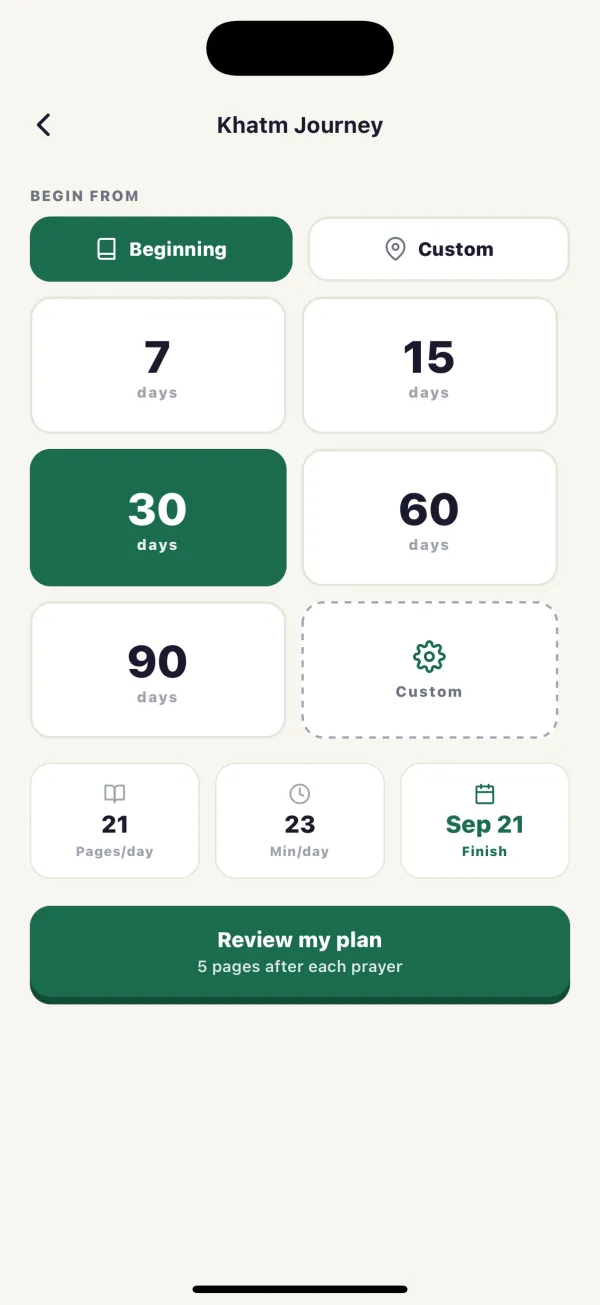
Pick a length and the plan resolves to pages a day, minutes a day and a finish date. Starting point is either the beginning or a custom position.
-
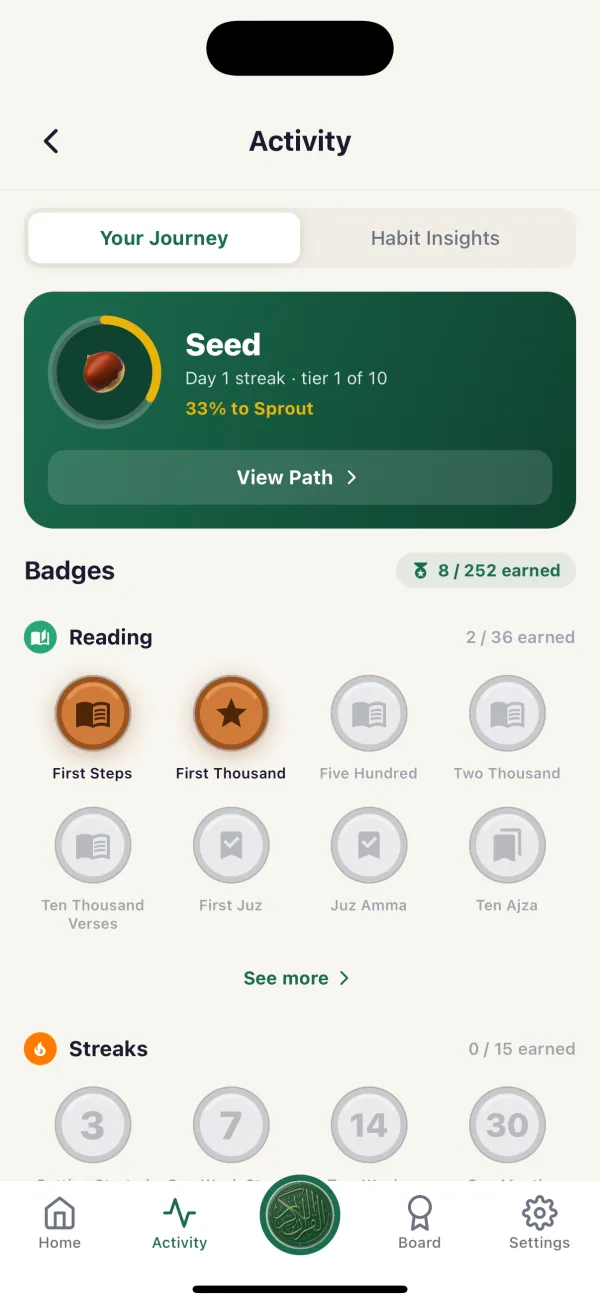
The journey runs through ten tiers, from Seed upward, alongside 252 badges. It is the progress map, not the reading itself.
-
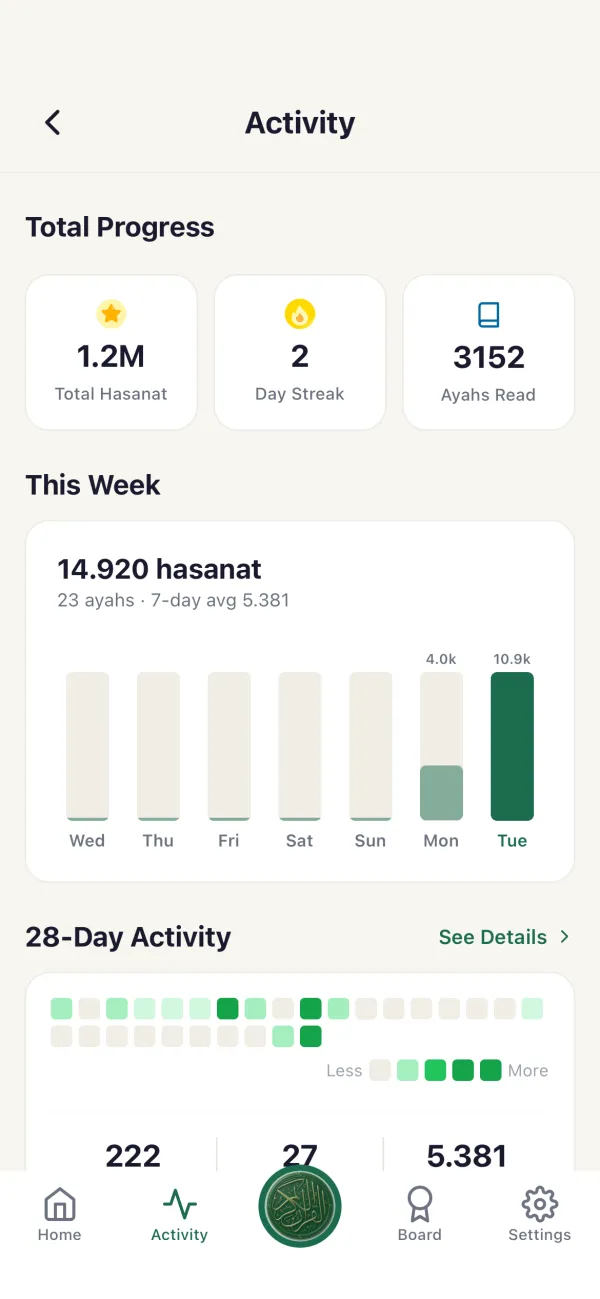
Hasanat are counted from the Arabic letters you read, at ten per letter, so the count follows the text rather than the clock.
-
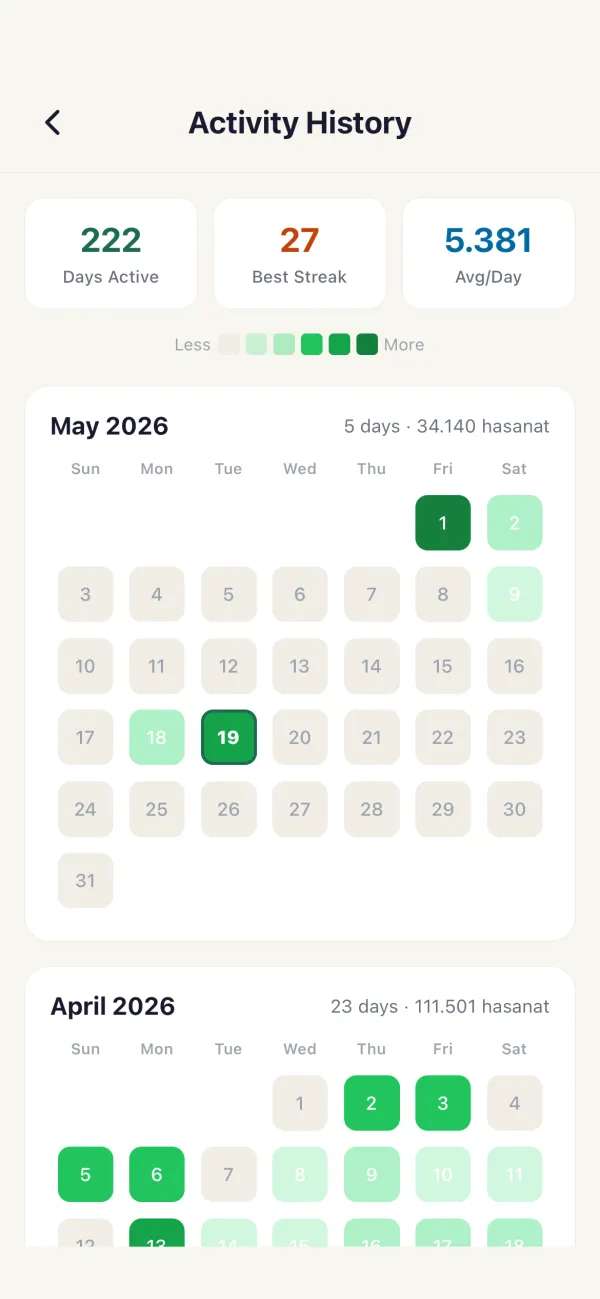
The history is a calendar, which makes a missed day visible without turning it into a verdict.
Quran Habit is on Google Play and the App Store.